

Anyone who studies luck-based games will discover Turbo Mines a fascinating subject. It’s a game that dresses up probability in basic clickable tiles. At its essence, it’s a mathematical problem. Every move you take is a bet with shifting odds. Grasping those numbers doesn’t take away from the fun. It changes how you play. You cease guessing and start making choices. This article will cover the fundamental math that drives Turbo Mines. We’ll see how your chances vary with each click and look at ways to approach the grid in a smart way. The goal is to give you the understanding to view the game for what it is and to put your bets with more assurance.
Grasping the Essential Game Mechanics
To start, let’s understand how Turbo Mines really operates. You see a grid of tiles. A fixed number of mines are placed behind them. Your task is to click tiles one at a time without striking a mine. Every empty tile displays a multiplier that grows your eventual win. You can cash out anytime to claim that multiplier, or you can keep going. The main difference from classic Minesweeper is the omission of “number clues.” You don’t get hints about nearby mines. Each additional safe tile is an independent event based purely on what’s left in the pool: remaining tiles and mines. This configuration creates a clear probability problem. Your only information is how numerous tiles you’ve uncovered and how many mines were placed at the start.
Critical Variables in Any Round
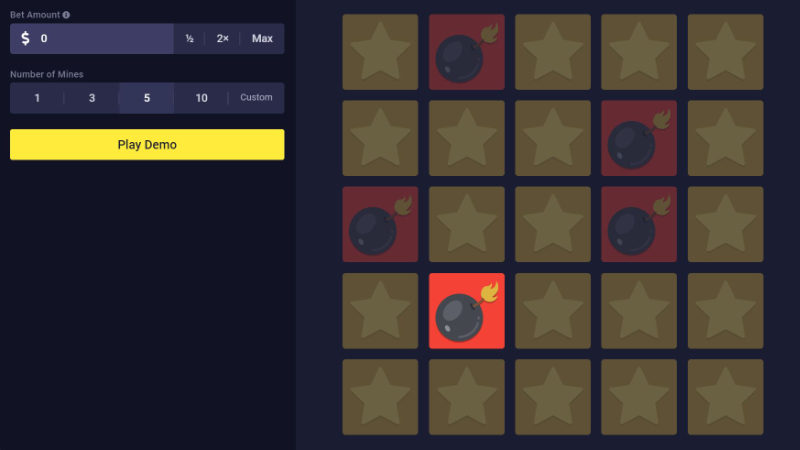
Any round of Turbominesgame commences with a couple of fixed numbers. The grid size, say 5×5, offers 25 overall tiles. The number of mines is also set from the beginning—for instance, 5 mines in that 25-tile grid. From your very first click, these numbers begin to interact. Your beginning chance of striking a mine is merely (Number of Mines) / (Total Tiles). But that chance shifts. It varies with every safe reveal because the pool of still available tiles gets diminished. This isn’t a game of drawing through replacement. Each pick impacts the next, a classic case of non-independent probability. Observing these moving odds is where strategic play begins.
The Collect Decision Stage
This is the point at which strategy really matters. The game presents a growing multiplier in your view, but the hazard rises at the same time. Zero strategy can ensure a profit. Each round is its personal self-contained puzzle of risk and reward. You can determine the numerical expectation, but the consequence is invariably binary: you alternatively cash out and win, or you reveal a mine and forfeit your stake. So, comprehending the mechanics hinges on handling that push and pull between greed and caution. Your guide through that tension is the group of cold, hard numbers that determine your chances at any individual step.
Comparing Turbo Mines to Traditional Minesweeper
The comparison feels obvious, but the two games differ fundamentally in how they leverage information and chance. Traditional Minesweeper is a game of pure deduction. Reveal a safe cell and it shows a number showing how many mines touch it. This offers precise local data to deduce where mines lie. You resort to probability when all else fails. Turbo Mines, meanwhile, is a game of statistical chance and risk management. You have no spatial information. The only figures that matter are the totals: initial squares, beginning bombs, and exposed squares.
- Type of Information: Traditional Minesweeper offers positional, deductive hints. Turbo Mines provides only aggregate statistical information.
- Skill Application: Traditional Minesweeper favors logical deduction and finding patterns. Turbo Mines rewards odds calculation and emotional discipline.
- Result Predictability: In Traditional Minesweeper, a perfectly logical player can always emerge victorious. In Turbo Mines, even a perfect mathematical player cannot guarantee a win on any given attempt. The chance element of the initial click after a cash-out decision makes it not feasible.
This difference is critical. If you view Turbo Mines as a reasoning challenge, you’ll feel irritated. You have to accept it for what it is: a progressive betting game where numbers shape your risks, but chance decides each spin.
The Basic Math of First Probability
Let’s begin with the most basic part. Visualize beginning a game on a 5×5 grid with 5 mines. On your first click, with all tiles untouched, you have 25 choices. Five of them are mines. Your likelihood of hitting a mine right away is 5/25. That simplifies to 1/5, or 20%. Your chance of picking a safe tile is 20/25, or 80%. This is easy arithmetic. The multiplier value shown on that first safe tile is set by the game’s own model. It isn’t a direct result of this probability. Keep the idea of survival chance separate from the reward multiplier. They’re linked in terms of risk, but the game determines them independently.
This initial probability is the only time the math stays this straightforward. Once you reveal a safe tile, everything changes. You now have 24 tiles left, but the number of mines is still 5 (assuming you didn’t hit one). The new chance of hitting a mine on your next click becomes 5/24. That’s about 20.83%. The chance of safety is 19/24, roughly 79.17%. Observe the risk has gone up, just a little. This small rise in danger persists with every safe click. This is the core mathematical rule of Turbo Mines: with every safe step forward, the path behind you vanishes, and the path ahead gets statistically more dangerous.
Determining Expected Value (EV) for Plan
Chance tells you the chance of something taking place. Expected Value (EV) indicates what that occurrence is worth on mean over many, many tries. In Turbo Mines, at any choice moment, the EV is calculated by weighing the possible profit against the possible loss, adjusted by their odds. The calculation is: EV = (Probability of Cashing Out * (Stake * Multiplier)) + (Probability of Hitting Mine * 0). Since striking a mine yields zero, that latter portion often falls out. A more practical pre-game calculation concerns the probability of attaining a specific multiplier level.
For example, what’s the likelihood of securely uncovering 5 tiles in a row? In our normal scenario, it’s the multiplication of each individual safe likelihood: (20/25) * (19/24) * (18/23) * (17/22) * (16/21). Calculate that and you get approximately 0.20, a 20% chance. If the multiplier for 5 tiles is, say, 3x, then the EV for attempting to achieve that stage from the beginning is (Probability of Success * (3x Stake)). This is a simplified representation. The true game’s payout structure has more intricacy. But the concept is crucial. A favorable EV suggests a decision that would be rewarding over countless repeats. Remember, each round is separate, and volatility can be unpredictable over a short session.
Why EV Alone Isn’t a Complete Guide
Leaning only on EV has drawbacks in a scenario like this. First, the computation assumes you know the exact multiplier steps, and these can vary. Secondly, and more crucial, it disregards your individual comfort with risk and the size of your bankroll. A strategy with a slight positive EV might drive you through long sequences where a single defeat destroys your current bankroll. I consider EV as a conceptual benchmark, not a absolute directive. It tells me if the game’s provided multipliers are fairly priced against the mathematical hazard. That assists identify times where playing more bold or more careful might be sensible.
Tactical Methods Based on Odds
With the math as our foundation, we can talk about real strategies. The central strategic decision in Turbo Mines is when to cash out. Since risk increases with every tile, a conservative strategy involves setting a low target multiplier and cashing out consistently. For instance, you might opt to always cash out after 3 safe tiles. This gives you a high probability of success on any single round, but your wins will be lower. An aggressive strategy aims for higher multipliers, accepting the much lower chance of getting there.
- The Fixed Target Strategy: Select a multiplier ahead of time, like 5x. Always cash out the instant you reach it, no matter how you feel. This forces control.
- The Percentage Risk Strategy: Set a maximum acceptable risk percentage. Determine how many safe tiles that represents. If you don’t want more than a 30% failure chance, cash out at the point where the risk matches that mark.
- The Progressive Adjustment Strategy: Begin with a conservative target. After a successful cash-out, use some of the profit to support a more aggressive try on the next round. This keeps your original bankroll safe.
No strategy eliminates risk. They only help you handle it. The secret is to select one that fits your goals and then stick to it. This avoids emotional decisions in the heat of the moment, which usually lead to chasing losses or giving back winnings.
The role of RNG and fair gaming
Any discerning player will ask: “Are the results truly random?” In electronic games like Turbo Mines, outcomes come from a Random Number Generator (RNG). A properly built and audited RNG ensures each tile’s status as a mine or safe is chosen randomly when the round starts. There’s no pattern to predict. This is the basis of fair play. For you, it means the probability calculations we’re talking about are accurate models of how the game behaves. “Hot streaks” or being “due for a loss” are not real. The odds for each click are determined purely by the remaining tiles and mines at that exact instant.
Recognizing the RNG drives everything supports using probability-based strategy over superstition. You can’t outsmart a genuinely random sequence. Your edge comes from controlling your decisions inside the known statistical framework. Reliable gaming platforms use provably fair systems where you can verify the randomness. As a player, knowing the game uses a certified RNG lets you trust the math you apply. It shifts your mindset from hoping for luck to executing a plan based on calculable risk. That’s a stronger, more satisfying way to play.
Frequent Fallacies Regarding Probabilities in Mines Games
A few persistent myths can wreak havoc on a user’s judgment. The primary involves the “Gambler’s Fallacy”: the idea that after a string of safe tiles, a mine is “due”. This is completely wrong. If you have remaining 10 tiles holding 3 mines, the probability for the next tile remains 3/10 (30%). It is irrelevant what happened during the previous 15 tiles. The past doesn’t influence the independent random event of the next click. An additional erroneous belief is that certain tile positions provide better odds. Across a grid with a truly random mine placement, every unclicked tile has exactly the same probability of containing a mine, given the current remaining mine count.
The Illusion of Control
Players frequently develop rituals or patterns, such as routinely commencing from a corner, thinking it improves their luck. This constitutes an illusion of control. While you choose which specific tile to click first, the mine layout was set randomly ahead of that click. Clicking the top-left tile instead of the center tile doesn’t alter the overall starting probability for that click. Understanding and disregarding these misconceptions is essential for clear, math-based thinking. It discourages you from making choices rooted in imaginary patterns and keeps your focus toward the variables you can actually control: your cash-out point and your stake size.
The way Probability Changes At Each Click
The changing odds are what make Turbo Mines so interesting to ponder. Every click that doesn’t end the game gives you perfect information. You understand the exact number of tiles left and the unchanged number of mines left. Let’s expand our example. Suppose you’ve successfully uncovered 5 safe tiles. Now, 20 tiles are left, with 5 mines still hidden. The chance your next click lands on a mine is 5/20, or 25%. If you confidently open 10 safe tiles, 15 tiles are left with 5 mines. That gives the probability 5/15, or 33.33%. This sequence isn’t straight in how it feels. The leap from 20% to 33% is a substantial rise in danger.
Mapping the Risk Curve
It assists to visualize this as a curve. The risk commences at a fixed point, like 20%, and ascends slowly at first. Then it becomes steeper as the number of safe tiles diminishes. Envision opening 15 safe tiles in our 5-mine, 25-tile scenario. Only 10 tiles would stay. The probability the next tile is a mine is now 5/10—a straight 50/50 coin flip. This is a major psychological threshold. The payout might look very tempting here, but you’re literally wagering on a coin flip. Understanding this curve lets you to set personal risk limits before you even start playing. That’s a indication of a methodical strategy.
Actionable Tips for Applying This Knowledge
So how do you bring all this theory to the virtual grid? First, always check the game settings at the start: grid size and mine count. Perform the quick mental calculation for the starting risk (mines divided by tiles). Second, decide your strategy before your first click. Are you playing for small, frequent wins, or aiming for a high multiplier? Set a clear cash-out point based on a tile count or a risk percentage. Third, control your bankroll without mercy. Never stake more on one round than you’re willing to lose. Even a 95% safe chance still fails 1 in 20 times.
- Start Small: Use the lowest allowed stake to test the multiplier steps and see how you react emotionally to the rising risk.
- Use a Probability Cheat Sheet: Keep a basic table handy. For a common setup like 5 mines in 25 tiles, recall: after 5 safe tiles, risk is 25%; after 10, it’s 33%; after 15, it’s 50%.
- Practice Disciplined Exits: When your pre-set target is hit, collect. Right then. Don’t let the next multiplier tempt you. The mathematical jump in risk is rarely worth the extra reward.
- Review Sessions: Analyze your play not in terms of wins and losses, but on whether you stuck to your planned strategy. This builds discipline for the long run.
The goal of understanding the math is not about “beating” the game in a surefire way. It’s to make informed choices, control what you expect to happen, and appreciate engaging with a well-designed system of chance. When you frame each click as a probability calculation, you change your play from reactive to proactive. That is what a thoughtful player does.